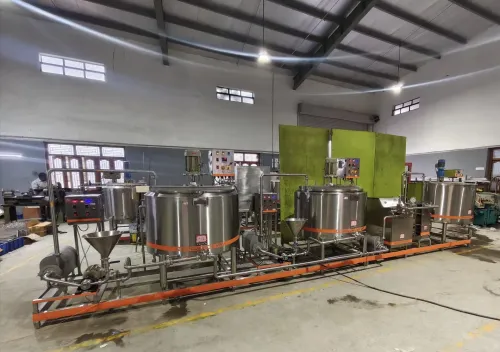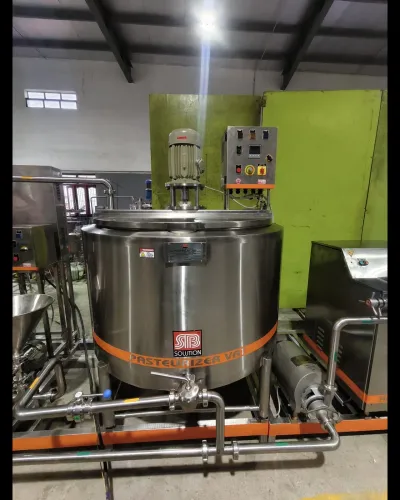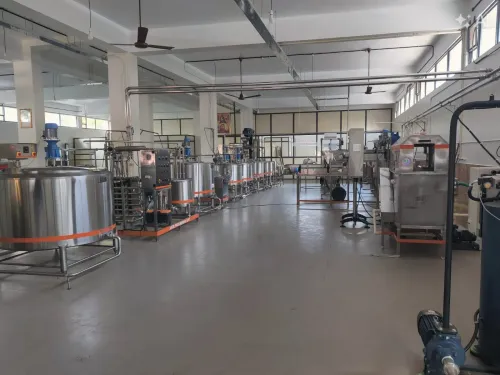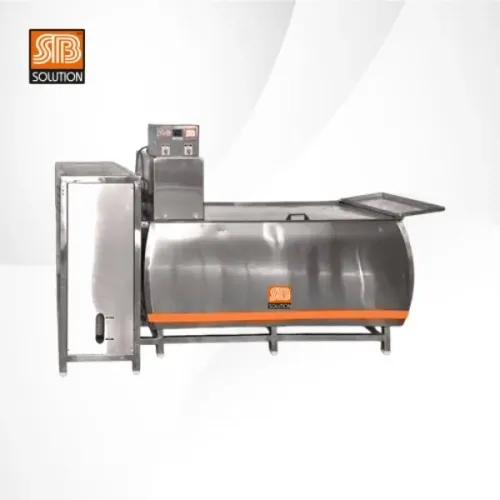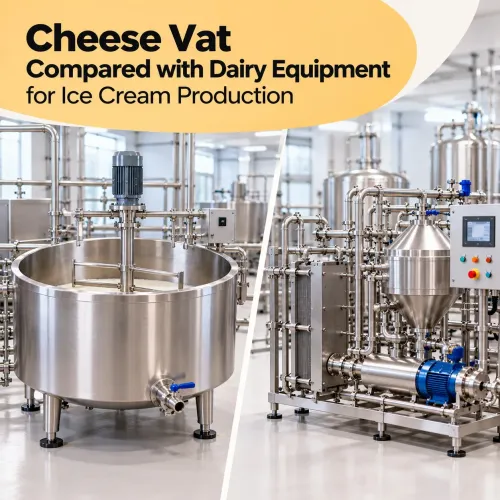
A quoted cheese vat rarely represents a complete cheese plant. You need to separate the vat’s included components from auxiliary systems, then compare capacity, process control, utilities, hygiene, installation and service before approving the purchase.
Key takeaways
- Separate the vat, optional accessories and customer-supplied utilities in every quotation.
- Compare working volume, heating method, temperature control and agitator design.
- Confirm CIP coverage, drainage, electrical load and installation clearances before ordering.
- Request drawings, material grades, warranty terms and commissioning scope from Coimbatore suppliers.
What belongs in a complete cheese vat equipment list?
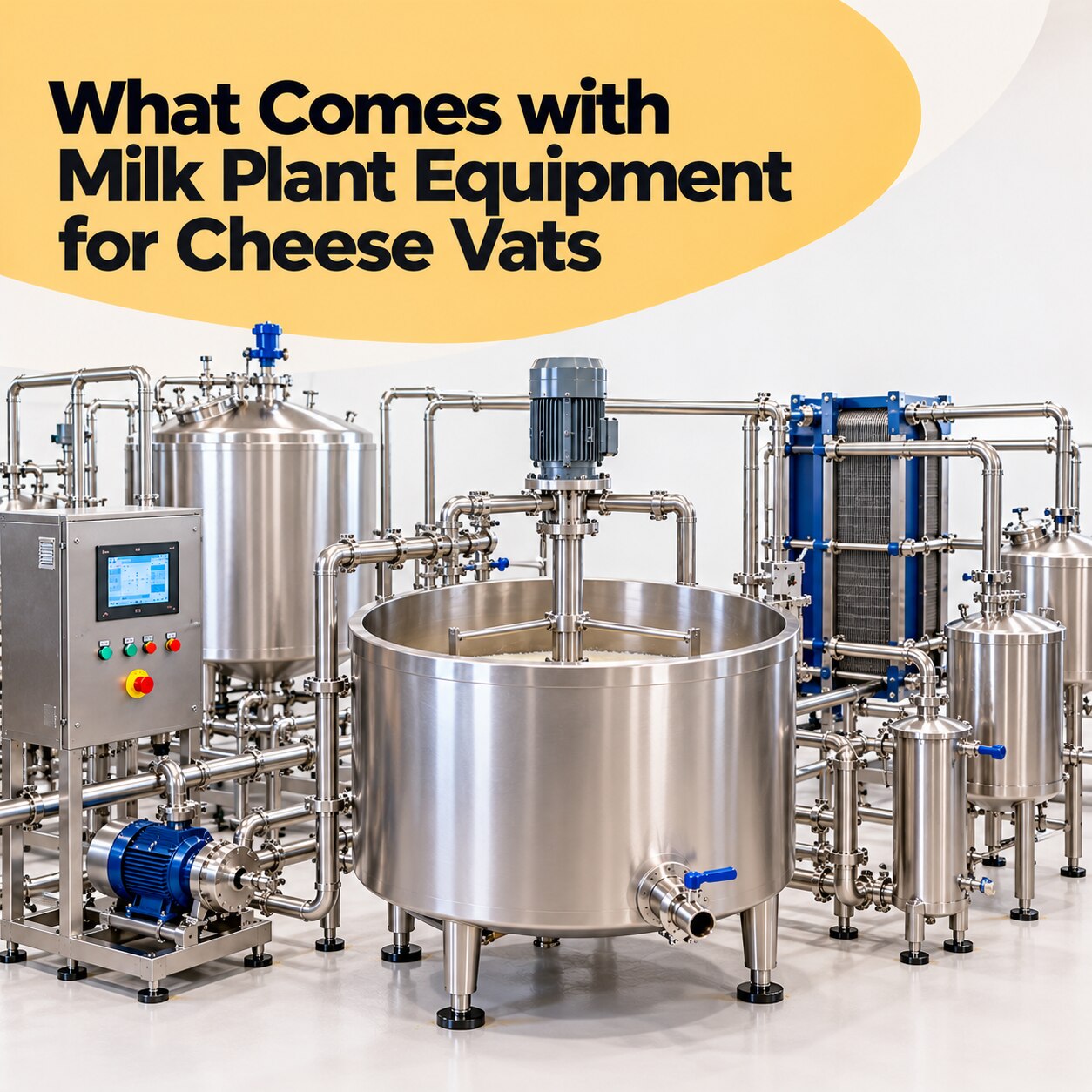
A “cheese vat” quotation covers the coagulation, cutting, cooking and stirring vessel—not a complete cheese plant. Your cheese vat equipment list should separate the standard vat package, optional items and customer-supplied utilities before you compare prices.
The vat package normally includes:
- Insulated stainless-steel product vessel
- Agitator, drive motor and gearbox
- Cutting knives or harps
- Heating-and-cooling jacket
- Product-temperature probe
- Control panel and operator controls
- Access covers and safety interlocks
- Product outlet and whey outlet
- CIP connections, sanitary valves, supporting pumps and connecting piping
The exact boundary still varies. Confirm every item against the supplier’s scope sheet.
| Scope | Normally associated with the vat | Separate purchase unless listed |
|---|---|---|
| Milk preparation | Vat inlet connection | Pasteuriser |
| Dosing | Vat access and controls | Culture or rennet dosing system |
| Heating | Jacket connections | Steam boiler or hot-water generator |
| Cooling | Jacket connections | Chiller |
| Cleaning | CIP ports and spray device | CIP skid |
| Whey handling | Whey outlet valve | Whey tank |
| Curd transfer | Discharge connection | Curd transfer pump |
| Forming and finishing | Product outlet | Mould filler, press and brine system |
| Records | Local temperature display | Data historian |
Ask for a battery-limit drawing. It must mark where the supplier’s valves, pumps and piping end, and where your plant utilities and downstream equipment begin.
Which cheese vat specifications determine process performance?
Compare cheese vat specifications by usable working volume, not gross vessel volume. Require the minimum and maximum milk charge, permitted fill level, headspace, foam allowance, batch cycle time and expected output in kilograms of curd or cheese. Partial loads change agitation and cutting, so a nominal litre figure misleads.
Specify 304 or 316L stainless steel, hygienic welds, EPDM, silicone or PTFE gaskets, a smooth surface finish, insulation, jacket design, heating and cooling duty, operating temperature range, ramp rate, drain diameter and electrical load.
| Cheese style | Agitator and cutter specification | Process consequence |
|---|---|---|
| Soft | Low stable speed, gentle motion, larger cut range | Protects fragile curd, retaining moisture and reducing fines |
| Semi-hard | Variable speed, controlled stirring, recipe-selected cut size | Balances whey release, yield and even texture |
| Hard | Higher controlled agitation, smaller cuts and stronger blades | Removes more whey without uncontrolled fat loss |
Specify impeller geometry, forward/reverse motion, cutter dimensions, cutting speed, blade material, cut-size range, recipe control and blade replacement method. Aggressive cutting creates fines and fat loss; under-cutting leaves oversized curd and uneven moisture.
- Verify the probe location, probe type, controller type, accuracy, response time and calibration records.
- Confirm alarm limits, batch-profile recording and that the displayed value represents milk temperature, not jacket temperature.
- Request heating and cooling duty, utility flow, inlet temperatures, temperature uniformity and ramp-rate guarantees.
- Ask for the lowest stable agitator speed and maximum speed, plus a guaranteed test using your milk volume and recipe to verify heating, cooling, cut size, curd loss, discharge time, CIP result and repeatability.
How does the vat fit into cheese production and the wider milk line?
1. Load filtered, standardised milk into the vat after reception, then heat it using the specified pasteurisation step. Homogenisation belongs upstream only when the cheese recipe needs it; it is not suitable for every curd structure.
2. Cool the milk to the culture temperature, add starter culture, and mix gently. Add rennet at the recorded time and hold without unnecessary agitation until the gel reaches the required firmness.
3. Cut the gel with knives or harps at the specified speed and cut size. Cut too aggressively and fat and fine curd escape with the whey; cut too coarsely and moisture control becomes inconsistent.
4. Stir the curd, raise the temperature for cooking, and hold the batch to develop the intended firmness. Keep whey drainage separate from curd discharge: specify the dedicated whey outlet, valve, diameter and receiving tank.
5. Remove whey by gravity where the vessel and layout permit. Use a low-shear pump for longer routes; a standard centrifugal pump can break fragile curd and increase fines. Screw or belt transfer suits controlled curd movement when gravity discharge is impractical.
6. Transfer curd to mould filling, pressing and brining, then move finished cheese to cold storage. The line may also include whey separation, whey storage and recovery equipment before cleaning through CIP.
The vat connects milk plant equipment from reception, filtration, standardisation and pasteurisation to downstream moulds, presses, brine tanks, chillers and CIP. Request a battery-limit drawing showing which pumps, piping and tanks are included.
A cheese-making kettle may use a different heating and agitation method; an open batch vat provides less enclosure and automation. A batch vat is unsuitable for continuous high-volume production, highly automated lines or curd processes requiring uninterrupted flow. Compare milk processing equipment in Coimbatore by process fit, not vessel name alone.
What utilities, cleaning systems and installation conditions does the vat require?
Before purchase, record the available steam pressure and quality, hot-water flow and temperature, chilled-water or glycol supply temperature and flow, electrical voltage and frequency, compressed-air pressure and quality, process-water analysis, drainage capacity and room ventilation. A local connection does not prove adequate pressure, temperature or flow.
A cheese vat equipment list should include these installation checks:
- Confirm foundation strength and floor loading, door width, lifting access, service clearance, operator access and the route for product, whey, utility and CIP piping.
- Request the supplier’s utility-consumption schedule and define controls for recipe steps, alarms, manual override, batch records and power or air failure.
- Specify CIP spray-ball coverage, required flow and pressure, vessel and jacket drainability, dead-leg limits, shaft seals, gasket compatibility and cleaning of knife assemblies that operators cannot reach.
- Validate detergent concentration, temperature, contact time, flow velocity, soil removal and rinse quality. Include loading, coagulation monitoring, draining, washing and cleaning verification in labour and batch-time estimates.
| Heating method | Temperature control | Condensation and utility effect | Cleaning impact |
|---|---|---|---|
| Direct steam injection | Fast, but dilution changes the recipe | Condensate enters milk; needs clean culinary steam | Steam contact can spread soil |
| Steam jacket | Even indirect heating | Requires steam and condensate drainage | Jacket must drain fully |
| Hot-water heating | Stable and gentle | Needs hot-water generator, flow and return | Adds a separate water circuit |
| Electric heating | Precise at low capacity | High electrical load; no condensate | Simplifies utilities but not CIP |
For milk processing equipment in Coimbatore, verify hygienic welds, drainable pipe runs and a dedicated or shared CIP circuit before accepting the quotation.
How should you compare cheese vat quotations and suppliers in Coimbatore?
For a milk plant equipment cheese vat in Coimbatore, compare the complete supply and documented performance, not vessel capacity alone. Request these documents before comparing prices:
- General-arrangement drawing and battery limits
- Utility-consumption schedule
- Material certificates for product-contact stainless steel
- Electrical diagram and instrument list
- Cleaning instructions and operating manual
- Warranty terms and spare-parts list
- Commissioning and acceptance-test procedure
| Compare | Ask the supplier to state | Why it matters |
|---|---|---|
| Instruments and controls | Probe location, controller, alarms, recording, recipe control | A displayed jacket temperature can hide cold milk |
| Valves, pumps and piping | Sanitary ratings, included whey and curd-transfer equipment | A standard centrifugal pump can damage fragile curd |
| Supply scope | Installation, training, commissioning, taxes and freight | A low quote can exclude essential site work |
| Performance | Heating and cooling time, uniformity, cut size, whey loss, discharge time, CIP result and batch repeatability | Nameplate capacity is not a production guarantee |
| Support | Response time, local technicians and spare-parts availability | A failed seal or probe can stop a batch |
Require the test to use your intended milk volume and recipe. Record detergent concentration, temperature, contact time, flow velocity and rinse quality during CIP, then repeat batches to expose inconsistent cutting or heating.
Inspect weld finish, drainability, gasket fit and access for cleaning. Confirm steam quality, chilled-water or glycol temperature, electrical supply, floor loading, drainage, door access and ventilation for Tamil Nadu conditions. Select Best Solution can be compared with other suppliers against these records, including local installation support, rather than a manufacturer title alone.
Related product
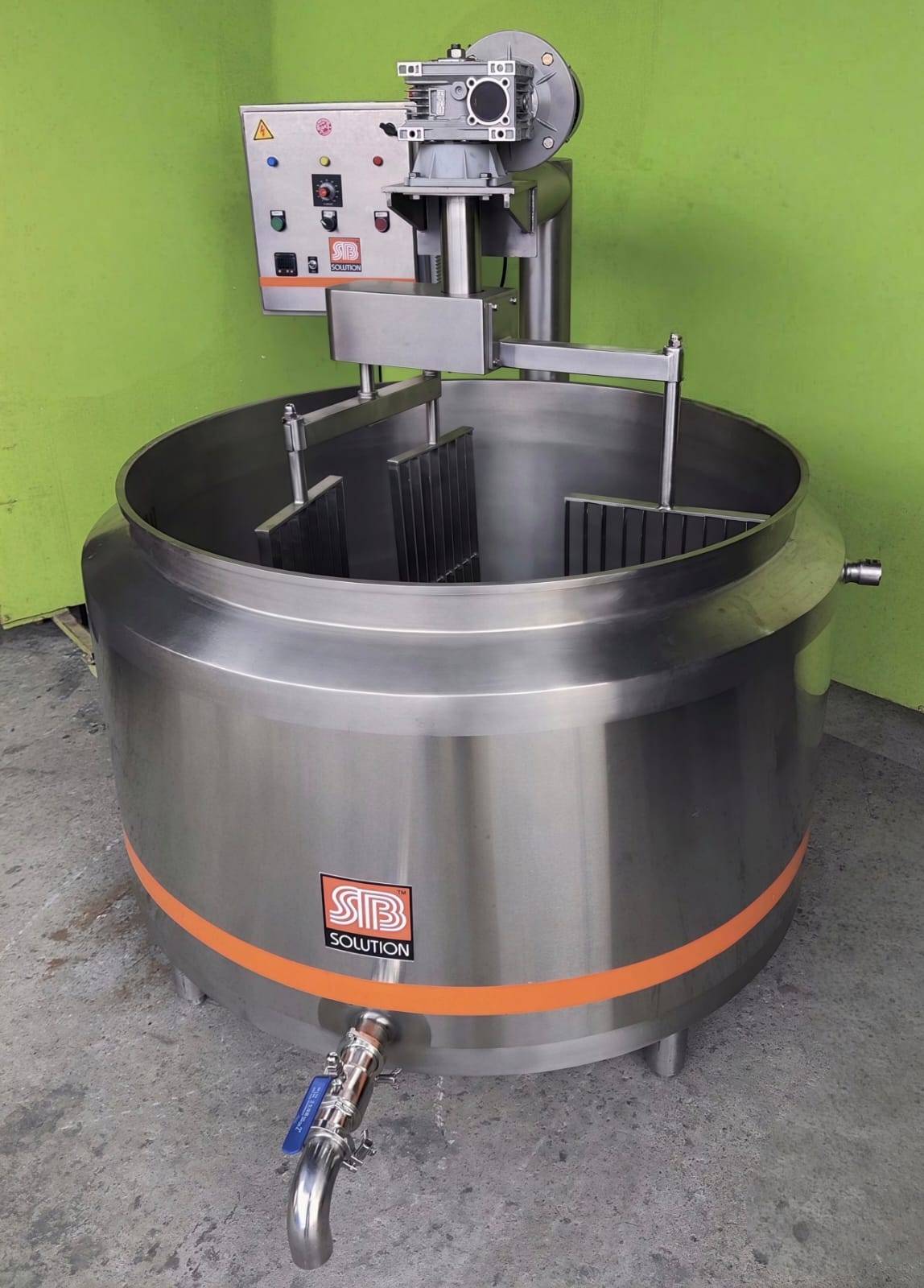 | Cheese Vat Manufacturers in Coimbatore - select best solution coimbatore View product → |
Frequently asked questions
What belongs in a complete cheese vat equipment list?
List the vat, lid, agitator, cheese knives, curd-cutting tools, controls, temperature sensors, outlet valve and supporting frame. Record optional items such as curd pumps, whey drainage equipment, platforms and CIP connections separately from customer-supplied steam, chilled water, compressed air and electrical services.
Which cheese vat specifications determine process performance?
Compare working and gross volume, product-to-vat ratio, stainless steel grade, heating method, temperature range, control accuracy, agitator speed and cutting-tool arrangement. These specifications affect curd size, cooking uniformity, whey release, batch time and cleaning access.
What utilities and installation conditions does a cheese vat require?
Confirm the required electrical load, steam or hot-water supply, cooling connection, compressed air, potable water, drainage capacity and CIP return route. Check floor loading, vat height, service clearances, delivery access and the space needed to remove agitator or cutting assemblies.
How should you compare cheese vat quotations from suppliers in Coimbatore?
Ask each supplier to price the same working volume and list included, optional and excluded items separately. Compare technical drawings, material certificates, control-panel scope, CIP design, installation, commissioning, warranty, spare parts and response arrangements alongside the equipment price.
Keywords