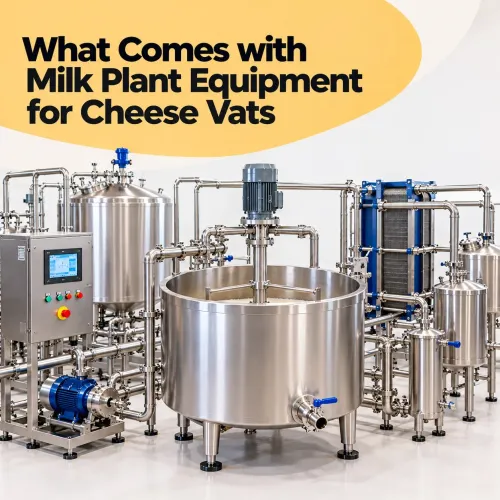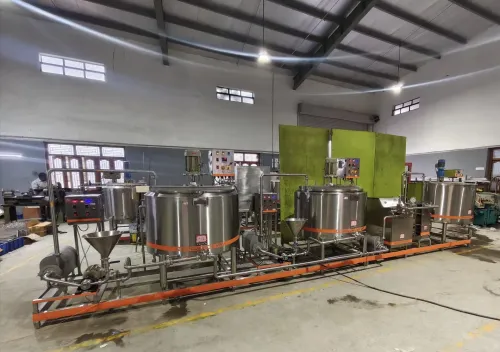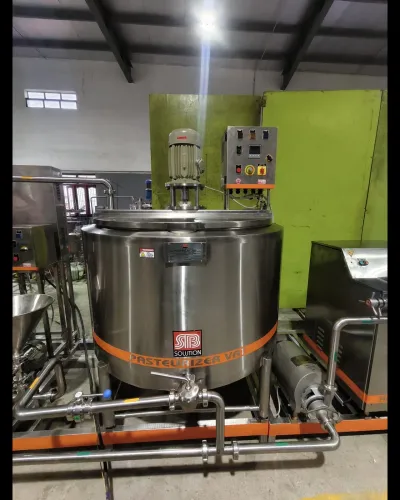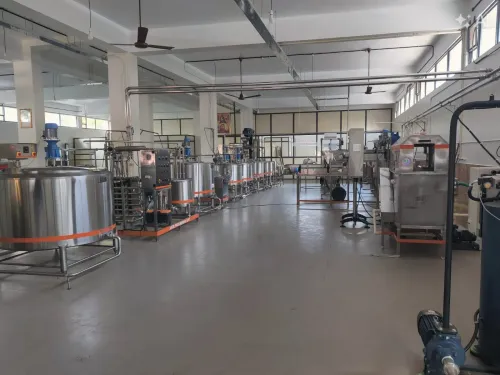
A cheese vat is not sized safely by its advertised litre count or selected by heating speed alone. You need to match working volume, curd handling, heat transfer, cleaning, controls, utilities, and service support to your cheese recipe and plant layout so the equipment performs consistently after installation.
Key takeaways
- Size the vat from working volume, not the nameplate capacity.
- Allow headspace for agitation, foam, curd, and whey movement.
- Match agitators, cutters, and drainage to your cheese style.
- Request weld, finish, control, and cleaning documentation before purchase.
Size the Vat by Working Volume, Not Its Nameplate Capacity
A 1,000-litre nameplate does not mean a 1,000-litre milk charge. Calculate the vat from milk volume per batch, product density, expected curd and whey yield, batches per day, and planned growth; then check floor space, cleaning access, and maintenance clearance.
| Capacity term | What it means | Risk if misunderstood |
|---|---|---|
| Gross volume | Total vessel envelope | Leaves less usable space than advertised |
| Rated working volume | Manufacturer-declared usable operating range | Confirms whether your smallest and largest batches mix and cut correctly |
Request this in writing:
- Minimum and maximum working volume
- Maximum fill level and required headspace
- Batch mass and product density
- Whether quoted capacity includes the agitator, curd knives, and outlet zone
- Expected curd and whey yield at your recipe
- Manufacturer’s working-volume declaration
A vat that is too large for a small batch can leave the agitator and knives poorly immersed, producing uneven mixing or cutting. An undersized vat forces extra batches, labour, cleaning cycles, and processing time.
For dairy processing equipment in Kannampalayam, compare the declared working range with today’s milk schedule and your expansion plan. Do not invent a percentage allowance for headspace or agitation; require the manufacturer to state the usable limits for your cheese vat.
Match Vat Geometry and Curd Handling to the Cheese You Make
Fresh cheese and paneer-style products suit open rectangular vats, where you can cut, drain, and transfer curd manually. Soft cheese needs gentler agitation and accurate cutting; hard cheese needs controlled syneresis, stronger drives, and repeatable curd size.
- Heat milk, add starter, and hold the recipe temperature.
- Add coagulant, allow coagulation, then make vertical and horizontal cuts.
- Stir slowly as curd firms, separate whey, and transfer curd through the outlet.
| Cheese style | Suitable design | Curd-handling priority |
|---|---|---|
| Fresh cheese | Open rectangular vat | Wide access, simple cutting, rapid whey removal |
| Paneer-style | Open vat or shallow kettle | Firm slabs, manual cutting, clean drainage |
| Soft cheese | Closed cylindrical vat | Low-shear blades, slow speed, reduced contamination exposure |
| Hard cheese | Closed cylindrical vat | Automated cutting, controlled agitation, high drive torque, CIP |
Specify wire spacing, knife geometry, and cutting speed against the intended curd size. Fine wires and fast cuts can shatter fragile curd; as syneresis progresses, excessive shear creates fines and lowers yield. Specify agitator blade shape, speed range, reversible direction control, and torque at the actual curd stage, not with water alone.
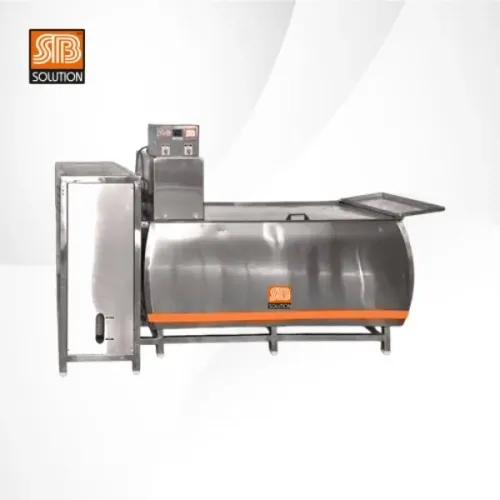
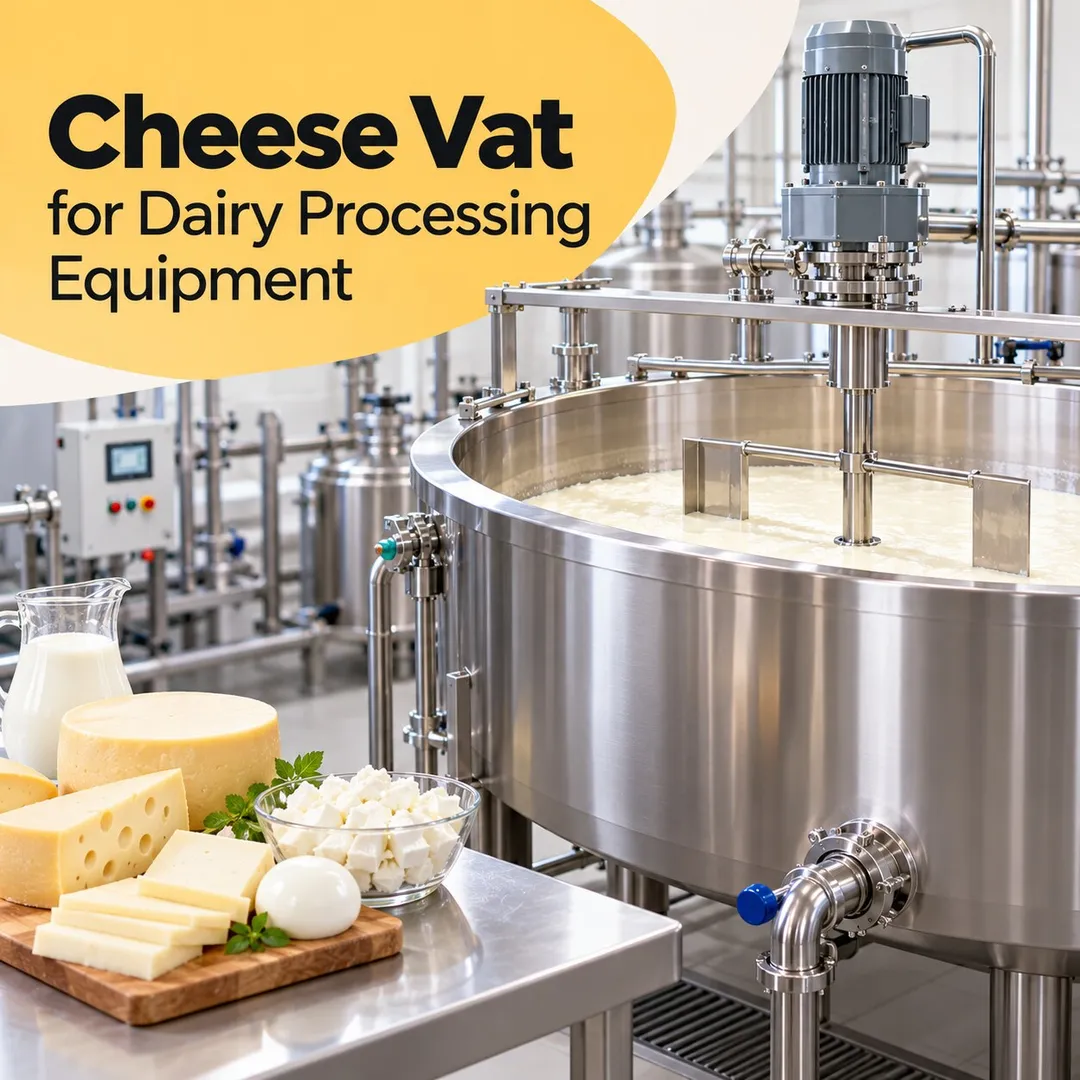
Closed cylindrical vats suit controlled agitation, automated cutters, and integrated CIP. Horizontal or open vats suit manual or semi-automatic cutting and whey removal. Request a trial using your recipe and target curd size, never a water or milk-only demonstration.
Check outlet access, drainage slope, residual hold-up around shafts and valves, and whey recovery before selecting cheese processing equipment in Tamil Nadu.
Compare Heating and Cooling Systems by Performance and Utilities
Choose the heating system by total utility demand, not jacket area alone. Steam heats fastest, hot water gives gentler control, and electric heating reduces some external connections.
| Option | Installation and utilities | Control, maintenance, and safety |
|---|---|---|
| Steam | Pressure-rated jacket, steam supply, traps, condensate removal, and suitable valves | Rapid transfer; validate controls and inspect traps, seals, and pressure protection |
| Hot water | Correctly sized heater, pump, flow circuit, expansion provision, and temperature buffer | Gentle, stable control; maintain pump, heat exchanger, water quality, and circulation |
| Electric | Adequate electrical load, cabling, isolation, earthing, and overcurrent protection | Simple utility layout; protect and inspect elements, which can foul, fail, or create hot spots |
Require a guaranteed temperature-rise test stating starting milk temperature, target temperature, batch mass, heating medium, available steam pressure or hot-water flow, agitation state, and allowable deviation. Milk requires about 4.18 kJ/kg·K; heating 1,000 kg through 30°C requires about 125 MJ before vessel losses and inefficiency. A 125 MJ promise without test conditions proves little.
For dairy equipment in Coimbatore, request cooling evidence for the actual batch range, not just a refrigeration-tonnage figure. Require a measured cooling curve naming coolant temperature, flow rate, agitation, recipe, product load, and allowable deviation. Fouling, viscosity, and excessive agitation can slow cooling or damage curd.
Ensure controls record product temperature, heating and cooling rates, agitation speed, and sensor alarms.
Specify Hygienic Construction, Controls, and Cleaning Evidence
A repeatable cheese vat is defined by documented materials, welds, drainage, controls, and cleaning tests—not by a polished stainless-steel exterior. Require the product-contact grade for the vat, jacket boundaries, agitator, knives, welds, fittings, and drains.
| Material | Suitable use | Check before purchase |
|---|---|---|
| 304 stainless steel | Some non-chloride milk-contact applications | Confirm cleaning chemicals, chloride limits, and corrosion protection |
| 316L stainless steel | Higher chloride exposure or aggressive cleaning | Confirm certificates for every product-contact component |
Specify continuous, smooth, fully penetrated product-contact welds where required, with no pits or crevices. Require pickling, passivation, or equivalent treatment, plus an internal finish target such as Ra ≤0.8 µm. The supplier must document the measurement method and each sampling location.
Request these details in the quotation:
- Outlet size, valve type, drain orientation, heating-surface area, and maximum residual hold-up.
- Agitator speed range, motor rating, direction control, and knife-shaft access.
- Product-probe location, calibration records, alarm behaviour, recipe access, data export, and sensor-failure response.
- CIP flow and pressure, spray coverage, shadow areas behind hubs and shafts, return circuit, gasket compatibility, and a riboflavin or equivalent coverage test.
- Every component requiring dismantling and manual cleaning; also request material certificates, jacket leak-test results, calibration records, and FAT documentation.
A spray ball alone proves nothing. Confirm that product, cleaning liquid, and jacket low points drain without stagnant pockets, then witness the cleaning test on the actual vat.
Choose Between a Cheese Vat, Kettle, Tank, and Continuous Line
A cheese vat is the better investment when you need repeatable curd size, controlled agitation, reliable whey drainage, and several batches or recipes each week—not merely a larger vessel.
| Option | Best fit | Main trade-off |
|---|---|---|
| Open cheese-making kettle | Small batches, simple recipes, manual cutting, low automation | Flexible and inexpensive to operate, but exposes product to contamination and gives less consistent cutting and drainage |
| Multipurpose processing tank | Several products sharing one vessel and limited floor space | Reduces equipment count, but specialised knives, agitation torque, drainage, and recipe repeatability may suffer |
| Cheese vat | Small-to-medium or growing production needing controlled cutting, whey removal, recipes, and semi-automatic operation | Higher purchase and cleaning complexity than an open kettle, but better repeatability and a clearer expansion path |
| Continuous cheese-processing line | High, steady throughput with stable recipes and trained operators | Requires the most capital, integration, commissioning, floor space, and operational discipline |
Choose a cheese vat when labour, contamination exposure, and batch variation cost more than the added equipment. A continuous line is the wrong first step when demand is irregular or recipes are still changing.
Ask a cheese vat supplier in Kannampalayam for:
- Utility-load drawings, foundation and access dimensions, steam or hot-water connections, and electrical load
- Commissioning, operator training, spare-seal availability, and service response times
- A product trial using your cheese style, curd size, cutting speed, agitation torque, and whey-drainage method
Select Best Solution belongs on the same shortlist as other local suppliers only when those documents, trials, and same-scale references support the claimed performance; location alone proves neither hygienic design nor commissioning capability.
Related product
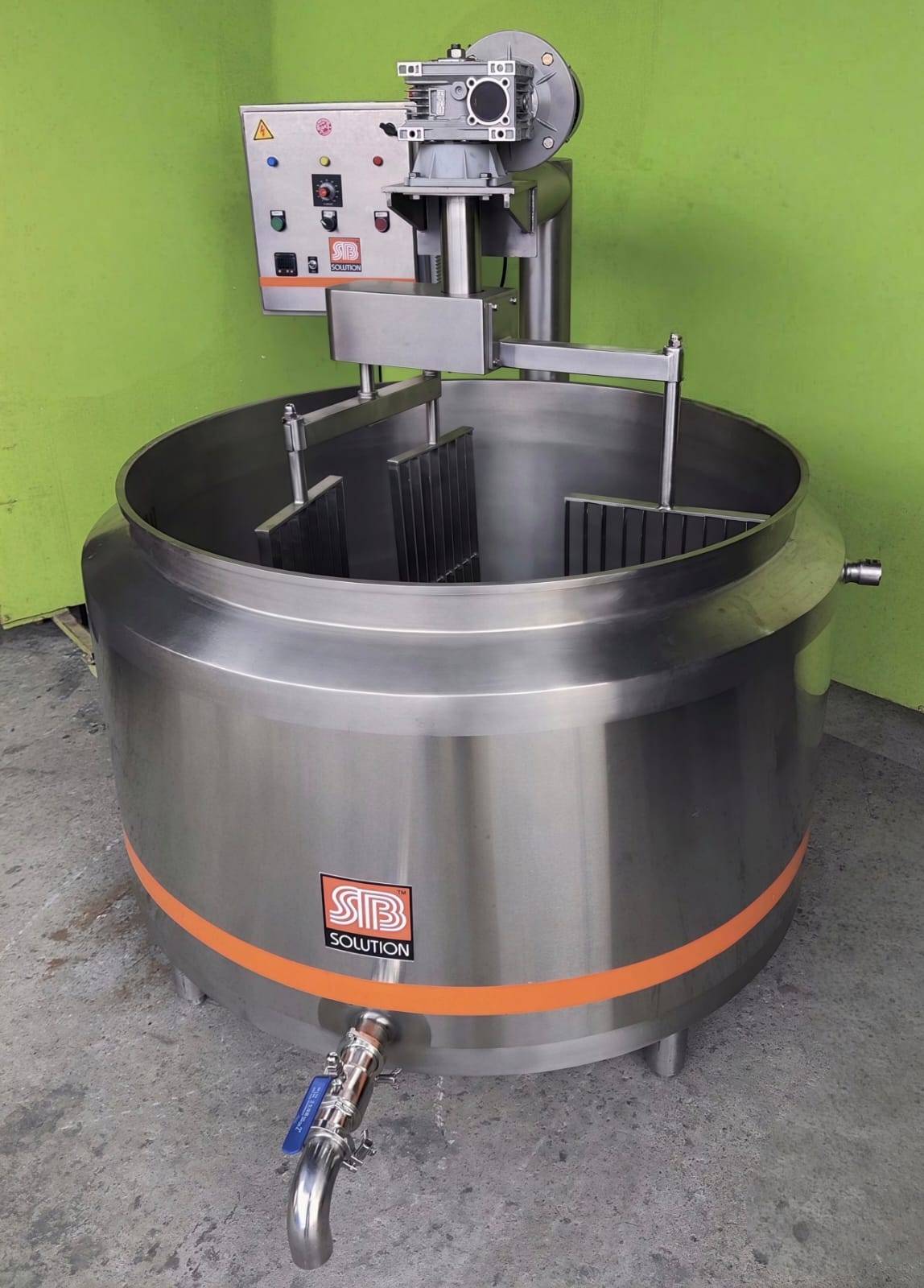 | Cheese Vat Manufacturers in Coimbatore - select best solution coimbatore View product → |
Frequently asked questions
How do you calculate the right cheese vat size?
Start with milk volume per batch, then account for headspace, product density, curd and whey yield, batches per day, growth, cleaning access, and maintenance clearance. A 1,000-litre nameplate does not necessarily accept a 1,000-litre milk charge.
What cheese vat geometry and curd-handling features should you compare?
Compare vat depth, shape, agitator design, cutter arrangement, outlet position, and curd-transfer method against your cheese recipe. Soft, semi-hard, and hard cheeses place different demands on cutting, stirring, draining, and curd handling.
How should you compare cheese vat heating and cooling systems?
Check heating and cooling response, jacket design, temperature control accuracy, available steam or hot-water capacity, chilled-water requirements, insulation, and heat-transfer performance at your batch size.
What hygiene and cleaning details belong in a cheese vat specification?
Specify food-contact stainless steel, hygienic welds, accessible seals, drainability, cleanable dead-leg-free pipework, spray devices, CIP compatibility, temperature controls, and documents that prove the stated materials and cleaning performance.
When is a cheese vat the wrong choice?
Choose a kettle for products needing concentrated cooking, a tank for storage or simple mixing, or a continuous line when throughput and repeatability exceed practical batch-processing limits.
Keywords