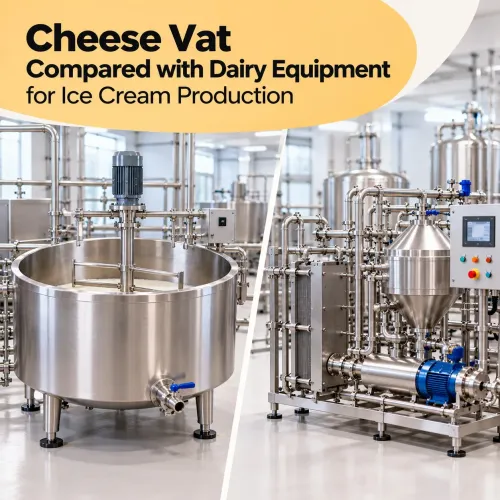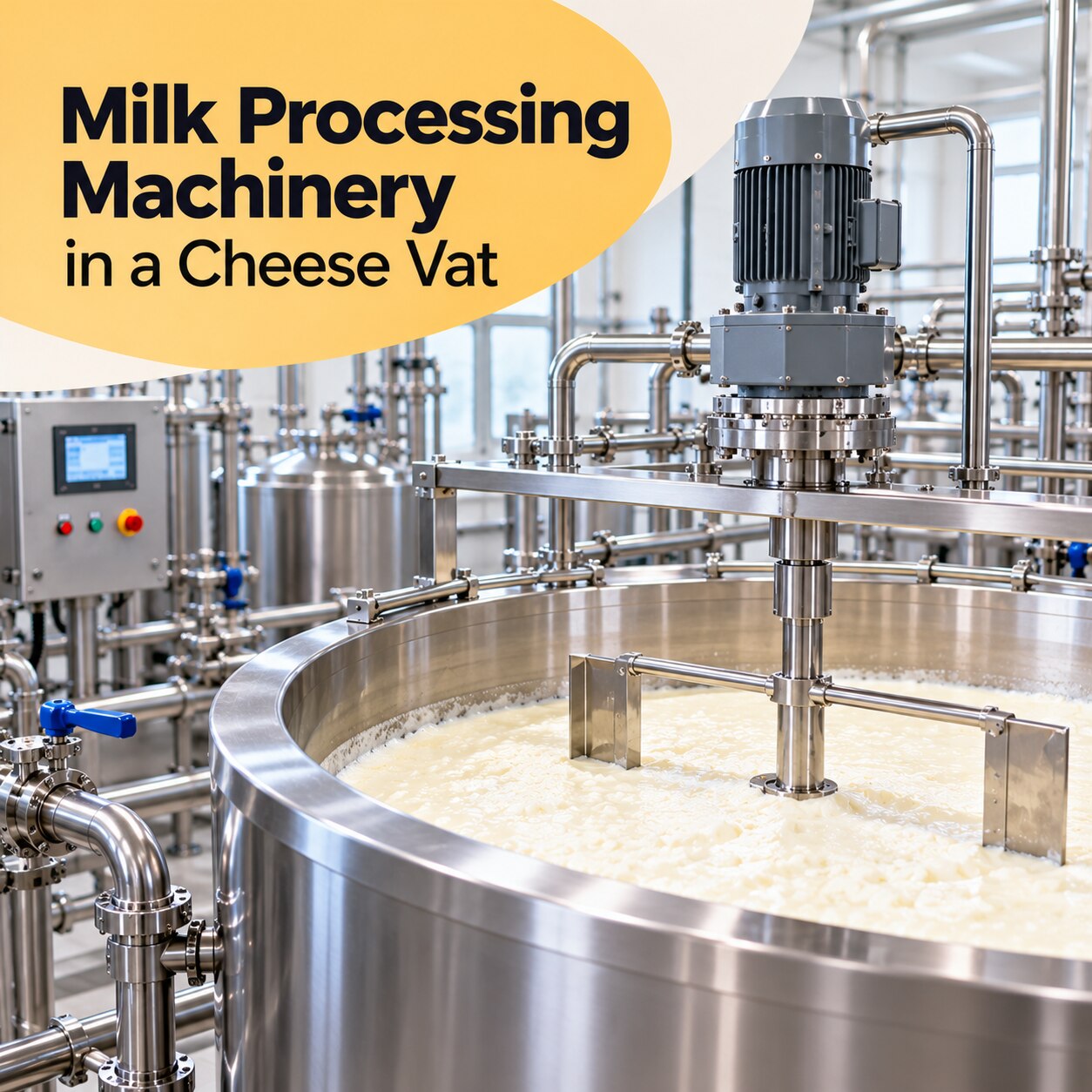
A cheese vat must control more than temperature: it must turn liquid milk into a firm gel, divide that gel without losing excessive fat and protein, expel whey at a controlled rate, and move the curd hygienically. By the end, you will understand each operating stage, how cheese styles change the settings, and which specifications reveal whether a vat fits your recipe and production schedule.
Key takeaways
- Match vat temperature and holding time to the cheese recipe.
- Use controlled cutting and agitation to protect curd size and moisture.
- Compare working volume, heating method, controls, and cleaning access.
- Confirm floor space, utilities, commissioning, and local service before purchase.
How milk moves through the cheese-vat process
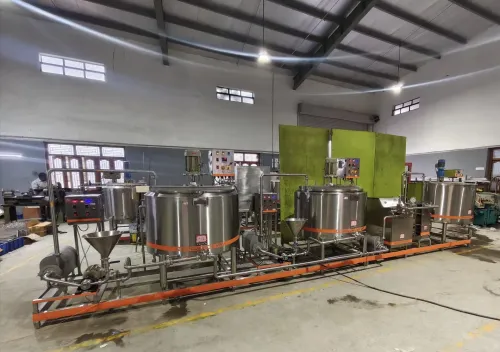
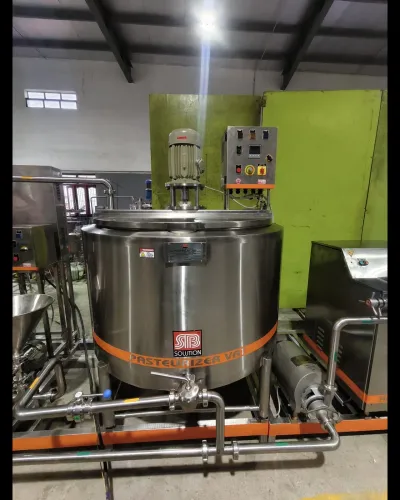
Milk enters the cheese vat through a controlled inlet, then moves through heating, culture addition, coagulation, cutting, stirring, whey removal, and curd transfer. The milk processing machinery keeps temperature and mechanical action within the recipe rather than treating the vat as only a heated tank.
1. Load filtered milk into the jacketed vessel, leaving headspace for agitation and foam. The working volume is lower than the vat’s gross volume.
2. Circulate hot water or steam through the jacket to bring milk to its recipe temperature. A temperature sensor measures the product, while the control panel regulates heating and records the batch.
3. Add starter culture and hold the milk for acidification. The agitator distributes culture evenly without breaking the developing structure.
4. Add rennet and stop or slow agitation so the milk forms a firm gel. Cutting before the gel reaches the required firmness creates fines and lowers yield.
5. Drive the curd knives through the gel at the specified speed and spacing. The knives divide it into uniform cubes, allowing whey to escape consistently.
6. Restart the agitator at low speed, then raise temperature when the recipe calls for cooking. Gentle movement promotes syneresis; excessive shear produces small, dry curd.
7. Remove whey through a screened outlet or drain system that retains the intended curd size. A liquid-only drain can carry curd fines away or blind its openings.
8. Transfer the curd through the outlet or a separate curd-handling system into moulds, hoops, or a pre-press. CIP connections then circulate cleaning solution through the vessel, jacket-side product circuits, outlet, and agitator assembly.
The cheese vat process does not replace validated pasteurization, such as 72°C for 15 seconds under HTST control. Confirm that the outlet, seals, sensors, and CIP circuit match the product-contact design.
Why cheese style changes temperature, time, and curd treatment
Soft cheese keeps more whey in a large, delicate curd, while hard cheese removes whey through finer cutting, stronger stirring, and cooking. That difference changes every stage after starter culture and rennet are added.
| Style | Coagulation | Cutting and stirring | Cooking and draining |
|---|---|---|---|
| Soft | Acid or rennet coagulation near 28–32 °C; hold until a fragile gel forms, often 30–90 minutes | Make large cuts, then stir gently to limit curd breakage | Little or no cooking; drain slowly in moulds or bags to retain moisture |
| Semi-hard | Rennet coagulation commonly around 30–35 °C; cut after the gel reaches a clean break, often within 30–45 minutes | Cut smaller cubes and stir steadily during healing | Raise the curd gradually, often to about 35–42 °C, then drain when the curd has contracted |
| Hard | Rennet coagulation commonly around 30–35 °C; use a firm gel before cutting | Cut into small, even particles and agitate enough to prevent clumping | Cook progressively, with the final temperature set by the recipe, then drain firmly for low moisture |
The cheese vat process must control the ramp, not merely reach a maximum temperature. A jacket heats indirectly, preventing steam or hot water from contacting milk; poor heat distribution creates local protein deposits and uneven syneresis.
Ask for the product-temperature ramp under a stated batch load, knife spacing, agitator speed range, and acceleration profile. A single agitator RPM does not predict curd treatment.
Do not treat the vat as a pasteurizer. HTST pasteurization requires at least 72 °C for 15 seconds in a validated system; cheese-vat conditions normally support culture, coagulation, curd cooking, and drainage instead.
How heating, cutting, and agitation control curd quality
Cutting a gel before it reaches the required firmness creates fines that carry fat and protein into the whey, reducing yield. Cutting too late leaves large, tough pieces and weakens moisture control. Use the gel’s firmness, not elapsed time alone, to set the cut point.
- Heating method: A jacket using controlled hot water or steam heats indirectly and evenly. Direct steam contact can dilute milk and create local overheating; uneven heating produces inconsistent moisture and texture.
- Knife design: Wire or blade spacing determines curd size. Sharp, hygienically accessible knives make clean cuts; damaged or widely spaced knives leave oversized pieces and increase breakage.
- Cutting speed: Move the knives steadily through the gel. Excessive speed shatters curd, while slow or interrupted cutting produces uneven particles and variable whey release.
- Agitation: The agitator keeps curd suspended during healing and cooking, supporting syneresis. High speed breaks curd and lowers moisture; inadequate movement allows settling and uneven cooking.
- Temperature control: Measure product temperature with a calibrated sensor and control the heating ramp, not just the maximum set point. A temperature overshoot drives out too much moisture and makes texture rubbery; cold zones leave soft, wet curd.
Jacket circulation must avoid stagnant hot spots, and the vessel, knives, agitator, outlet, and sensor must be cleanable through the CIP system. Inspect knife mounts and seals for trapped curd. Specify agitator speed range, acceleration, cut size, heating-medium type, and control accuracy when comparing milk processing machinery.
How to read cheese vat specifications before comparing machines
Compare cheese vat specifications by working volume and batch size, not gross volume alone. Headspace affects agitation and foam control, so a 1,000-litre gross vat may not process a 1,000-litre batch. Request the vessel orientation and the exact recipe load used for every quoted figure.
| Field | Request from the supplier | Why it matters |
|---|---|---|
| Capacity | Gross volume, working volume, minimum and maximum batch size | Prevents misleading capacity comparisons |
| Heating | Jacketed or other indirect method, heating-medium type, heat-transfer area, ramp rate under a stated load | Shows whether cooking is even; nominal steam pressure does not |
| Control | Product temperature range, sensor location, control accuracy, recipe and data-logging functions | Reveals whether coagulation and cooking are repeatable |
| Agitation and cutting | Agitator speed and acceleration range, knife layout, wire or blade spacing, cut size | RPM alone cannot predict curd breakage or whey expulsion |
| Drainage | Outlet diameter and position, whey drain, curd-transfer method, pump or gravity discharge | Determines transfer time and curd damage |
| Materials | Stainless-steel grade, surface finish, weld finish, gasket elastomer and temperature limit | “Food-grade stainless steel” is too vague |
| CIP | Fixed spray device, flow rate, chemical and temperature limits, return path and drainability | Confirms that internal surfaces can be cleaned |
| Utilities | Electrical load, steam or hot-water pressure and flow, cooling-water demand, compressed air, water and drain connections | Exposes installation and operating requirements |
Ask for a material certificate and utility-consumption figures at your intended batch size. Compare the product-temperature ramp, not the jacket’s maximum rating. A supplier that omits batch conditions has not given you a like-for-like specification.
How to size a vat and verify local installation support
1. Calculate the required working volume from the shift, not from the vat’s headline capacity. Use: batches per shift = available processing hours ÷ complete cycle time. Include loading, culture and rennet stages, cutting, cooking, whey drainage, curd transfer, wash-down, and CIP.
Then use: working volume per batch = total shift milk volume ÷ batches per shift.
2. Add headspace before choosing the gross vessel volume. A vat cannot be filled to its shell capacity because agitation, foam, and curd movement need room. Ask for both figures in litres: maximum working volume and gross volume.
Reject a quotation that gives only “1,000-litre capacity” without stating batch size, fill limit, recipe, and cycle time.
3. Match the calculation to the recipe. A vat designed for one large semi-hard cheese batch may be inefficient for several small soft-cheese batches, where cleaning and transfer time dominates. Confirm heat-transfer area, heating medium, temperature range, agitator and knife speed, drain arrangement, electrical supply, water, steam, compressed air, and floor loading.
4. Verify support before ordering milk processing machinery for a cheese vat in Kannampalayam or cheese processing equipment in Coimbatore. Ask the supplier to provide a commissioning plan using your milk and recipe, temperature mapping records, CIP coverage checks, calibration results, and operator training.
- A named technician available for installation and breakdowns
- Stocked food-grade seals, gaskets, temperature sensors, and knife components
- Acceptance tests for heating, agitation, drainage, controls, and CIP
- Response times, spare-part lead times, manuals, drawings, and maintenance schedules
Select Best Solution should answer these points with documents, not location alone.
Related product
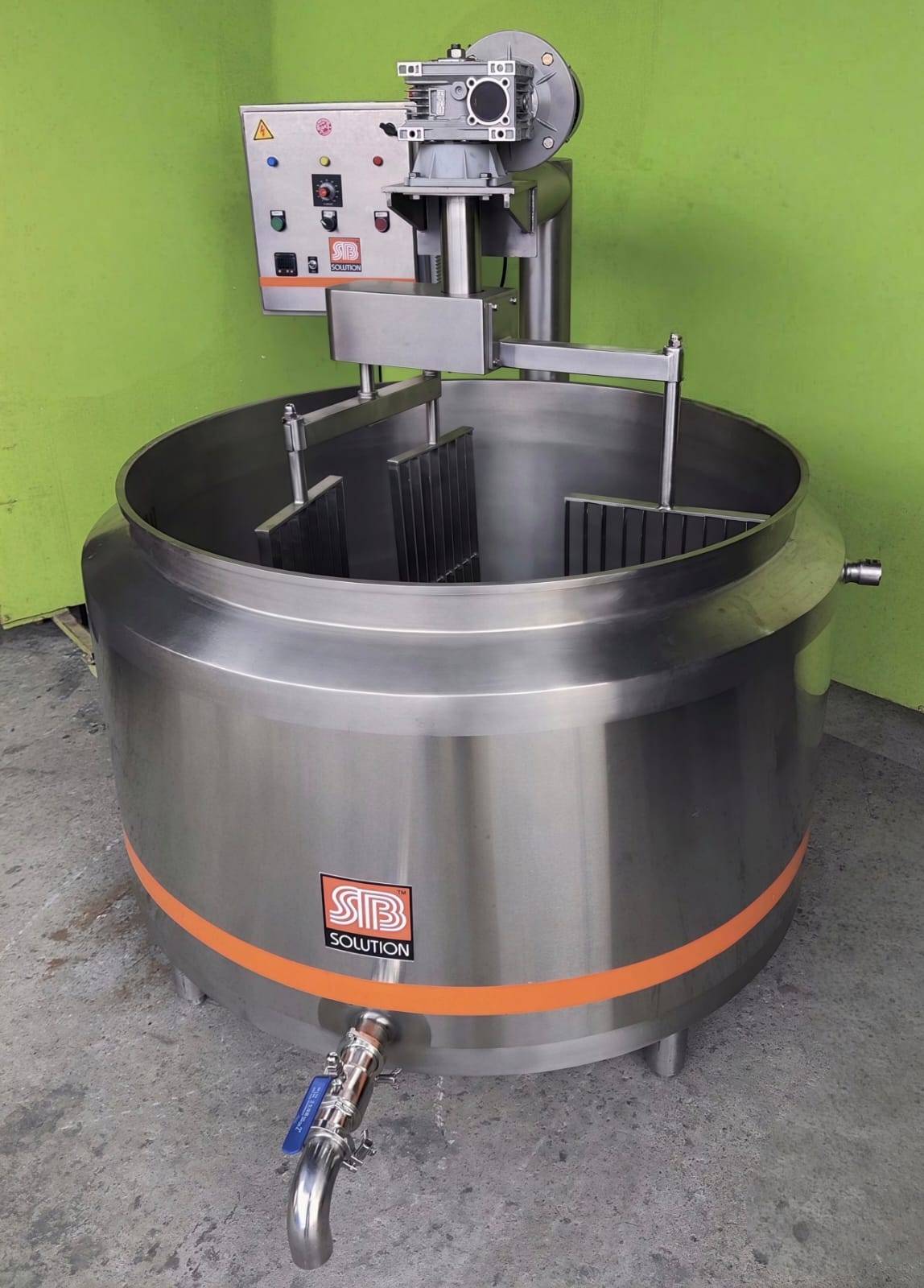 | Cheese Vat Manufacturers in Coimbatore - select best solution coimbatore View product → |
Frequently asked questions
How does milk move through the cheese-vat process?
Milk enters through a controlled inlet, then passes through heating, culture addition, coagulation, cutting, stirring, whey removal, and curd transfer.
Why do cheese styles require different vat settings?
Cheese style determines the target temperature, culture and coagulation time, curd size, stirring intensity, whey removal method, and final moisture.
How do heating, cutting, and agitation affect curd quality?
Even heating supports consistent coagulation, uniform cutting creates predictable curd size, and controlled agitation removes whey without damaging the curd.
What should you check in cheese vat specifications?
Check working volume, total volume, product-contact steel grade, heating method, temperature range, agitator speed control, cutting tools, outlet design, cleaning access, and control-system features.
How do you size a cheese vat and verify local installation support?
Size the vat from batch volume, milk expansion and working clearance, production schedule, and curd-transfer capacity. Confirm floor space, power, water, drainage, access routes, commissioning, spare parts, and service coverage in Coimbatore or Kannampalayam.
Keywords