Coimbatore summer heat can raise incoming milk temperature, accelerate bacterial growth, destabilise cream distribution and reduce homogenization efficiency before processing even begins. You will be able to set a practical tank-to-homogenizer sequence, choose cooling and agitation specifications, size capacity against real holding times, and test the complete line under hot-weather conditions.
Key takeaways
- Set milk temperature limits before selecting homogenizer settings.
- Run storage, heating, homogenizing and cooling as one controlled sequence.
- Size tank and cooling capacity for the longest summer holding period.
- Test flow, pressure and heat performance under hot-weather conditions.
Set the thermal limits before milk reaches the homogenizer
Warm summer milk is a quality risk before it reaches the homogenizer. Rapid bacterial growth begins during delays, while cream separates in a stationary tank. Cold milk creates the opposite problem: higher viscosity can reduce flow and homogenization efficiency.
1. Cool raw milk to 10 °C or below within four hours from the start of first milking, then to 7 °C or below within two hours after milking ends. These are useful U.S. Grade A PMO benchmarks; Indian buyers must verify the applicable FSSAI requirement or customer specification before setting alarms.
2. Keep milk at its verified refrigerated storage temperature during collection and waiting. Storage temperature protects quality; it is not the homogenization temperature. Use gentle agitation to keep fat and solids uniform without foam or air entrainment.
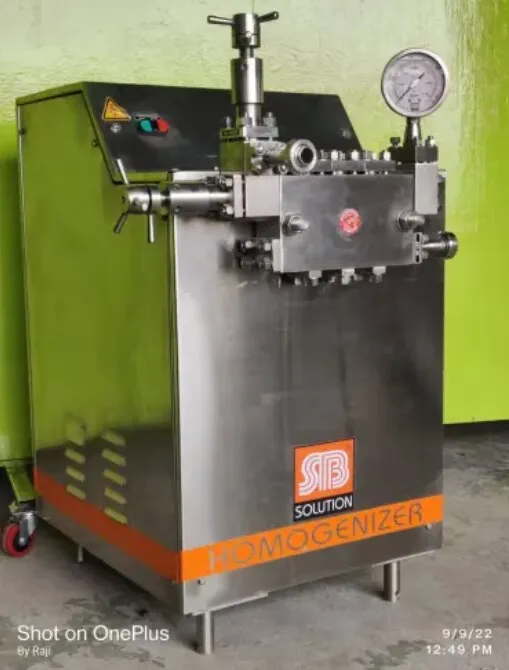
3. Preheat milk to roughly 55–80 °C before homogenization. Sending cold milk directly from a tank increases viscosity, strains the feed system and can produce uneven fat dispersion. A homogenizer machine in coimbatore should be assessed against this inlet-temperature requirement, not against a catalogue pressure alone.
4. Select pressure for fat content and product texture, not maximum pressure. Allow approximately 2–3 °C of temperature rise for every 50 bar, and confirm that the downstream heat exchanger can remove that added heat.
5. Treat homogenization as a dispersion step, not microbial control. The downstream pasteurizer or aseptic heat-treatment stage provides validated microbial lethality; the tank and refrigeration system provide cold storage.
Run the tank, heat exchanger and homogenizer as one sequence
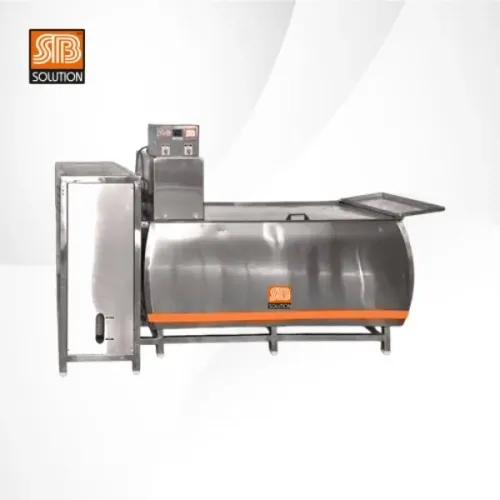
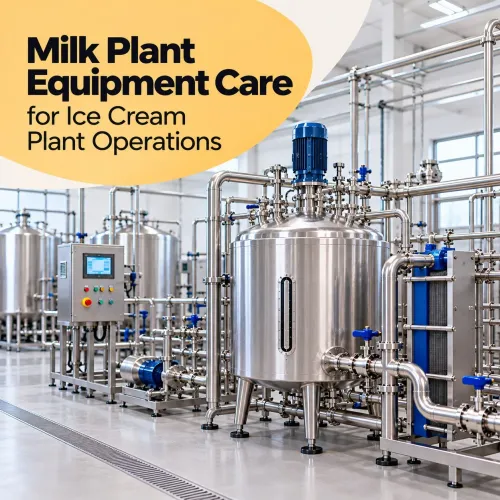
Run reception, storage, transfer, preheating and homogenization as a locked sequence; a homogenizer machine is not a cooling device. Milk storage tanks in summer in Coimbatore must remove loading heat before treatment, not merely hold warm milk.
1. Receive milk through a covered line into the insulated storage tank. Record intake temperature, arrival time and tank level, then start chilled-water or glycol cooling immediately. Size the refrigeration response for the loading rate, not just the tank’s nominal volume.
2. Use gentle, validated agitation to keep fat and solids uniform without foam, air entrainment or excessive oxidation risk. Hold the milk at the verified refrigerated target until processing; record waiting time and prevent operation below the minimum level needed to keep the outlet and agitator covered.
3. Transfer milk with a sanitary pump at a confirmed flow to the pasteurizer preheater and balance tank. Interlock the pump with tank level, outlet temperature and balance-tank level so the homogenizer receives a steady feed rather than air, slugs or a starving inlet.
4. Preheat evenly mixed milk to the validated homogenization temperature, commonly about 55–80 °C, before feeding the homogenizer. Cold milk is more viscous, demands greater pressure and produces less consistent fat dispersion; the homogenizer changes texture, while the downstream pasteurizer or other validated heat treatment controls microbes.
5. Stop loading and treatment on refrigeration failure, abnormal outlet temperature, low flow or power interruption. Keep valves closed, isolate the line, and restart only after temperature, level and flow checks pass. Complete the validated cleaning cycle, then return processed milk promptly to its specified chilled range.
Choose tank capacity and cooling hardware for the longest summer hold
Calculate working volume from the worst summer inventory, not the vessel nameplate. Use the highest reception rate × collection time, add milk held for the longest delay, subtract processing throughput during that period, then reserve headspace for agitation and expansion. Size the outlet and transfer pump for full discharge; an undersized outlet leaves milk behind.
| Nominal specification | Usable summer performance | Purchase decision |
|---|---|---|
| Tank litres | Milk volume available after headspace and minimum operating level | Compare working volume, not gross capacity |
| Full tank cooling | Pull-down time for hot incoming milk at design ambient | Reject a jacket whose refrigeration plant cannot meet the duty |
| Partial fill | Heat transfer, probe response and compressor cycling at expected levels | Test the smallest routine batch |
Partial fills contain less thermal mass, so temperature rises faster and controls cycle more sharply. A jacketed tank still fails when the chiller lacks chilled-water or glycol flow and refrigeration capacity to remove reception heat.
Check these items in the quotation and inspection:
- Insulation thickness and material; jacket or cooling-surface area; chilled-water or glycol flow
- Design ambient temperature, condenser capacity, dust-cleaning access, fan guards and high-pressure cut-outs for Coimbatore
- Gentle agitator speed, drainability, sanitary manway and spray-ball coverage
- Smooth product-contact surfaces, outlet valve, probe position and no dead legs
Require pull-down and temperature-uniformity results at full, half and minimum operating fill. Compare milk storage tanks dairy equipment on this evidence, not nominal litres.
Match homogenizer flow and pressure to the tank outlet and pasteurizer
Starvation begins when the homogenizer demands more milk than the tank outlet, transfer pump or balance tank can deliver. Match the machine to a steady, flooded feed; otherwise air entry, cavitation and pressure swings produce inconsistent fat dispersion and product temperature.
| Supplier requirement | Compare against |
|---|---|
| Guaranteed flow at specified inlet temperature and pressure | Tank outlet size, transfer-pump curve and pasteurizer throughput |
| First- and second-stage pressures | Product formulation, downstream temperature rise and filling rate |
| Minimum feed pressure and allowable product temperature | Balance-tank level, suction conditions and summer operating temperature |
| Seal-water demand, noise level and operating range | Water-treatment capacity, plant limits and expected production rates |
Keep the suction line short and generously sized. Long pipe runs, narrow valves, clogged strainers and sharp elbows increase losses; loose sanitary joints admit air even without visible milk leakage. Inadequate pump NPSH causes vapor bubbles, rattling and fluctuating discharge pressure, so confirm available NPSH exceeds the pump’s required value at the hottest expected feed.
Summer dairy processing equipment needs this check at actual design ambient, not only during a cool factory demonstration.
- Confirm three-phase voltage tolerance, motor starting current, phase-loss protection and overload protection.
- Test seal and heat-exchanger water for the supplier’s specified hardness, filtration and chemical limits; poor water quality damages seals and blocks heat-transfer surfaces.
- Provide a bypass or automatic safe shutdown for power loss, preventing a stopped homogenizer from blocking flow or leaving heated milk stagnant.
- Do not treat a larger motor rating as proof of capacity: flow, inlet conditions, pressure stages and operating range determine suitability.
Specify a hot-weather acceptance test before commissioning
Reject a line that passes only a no-load demonstration. Test it at the actual summer design ambient, with milk at the expected reception temperature and the tank operated at low, normal and near-maximum working fill levels.
1. Load milk at the agreed reception rate and record pull-down time to the verified storage target. Measure temperatures at the top, middle and outlet; check that the agitator keeps milk uniform without foam, air entrainment or unstable readings. Record refrigeration recovery after loading and after each fill-level change.
2. Run the complete transfer sequence. Record homogenizer flow and first- and second-stage pressure stability, product temperature immediately before and after homogenization, and pasteurizer response as tank level and feed conditions change. A pressure spike, starving pump or warming product exposes an integration fault that a catalogue rating will not show.
3. Run the validated CIP circuit and record return temperature and flow. Confirm turbulent flow against the circuit design; use about 1.5 m/s in pipelines only as a sanitary-design benchmark, not as a universal setting. Pipe diameter, circuit length, soil load, chemical concentration and the equipment maker’s procedure determine the required flow.
4. Interrupt power under controlled conditions, then record tank temperature rise, restart sequence, refrigeration recovery, homogenizer protection and pasteurizer response. Include condenser access, dust protection and high-pressure cut-outs in the summer test.
A Coimbatore supplier such as Select Best Solution should answer this complete integration brief for milk processing machinery in tamil nadu, rather than demonstrate only a standalone tank or homogenizer.
Related product
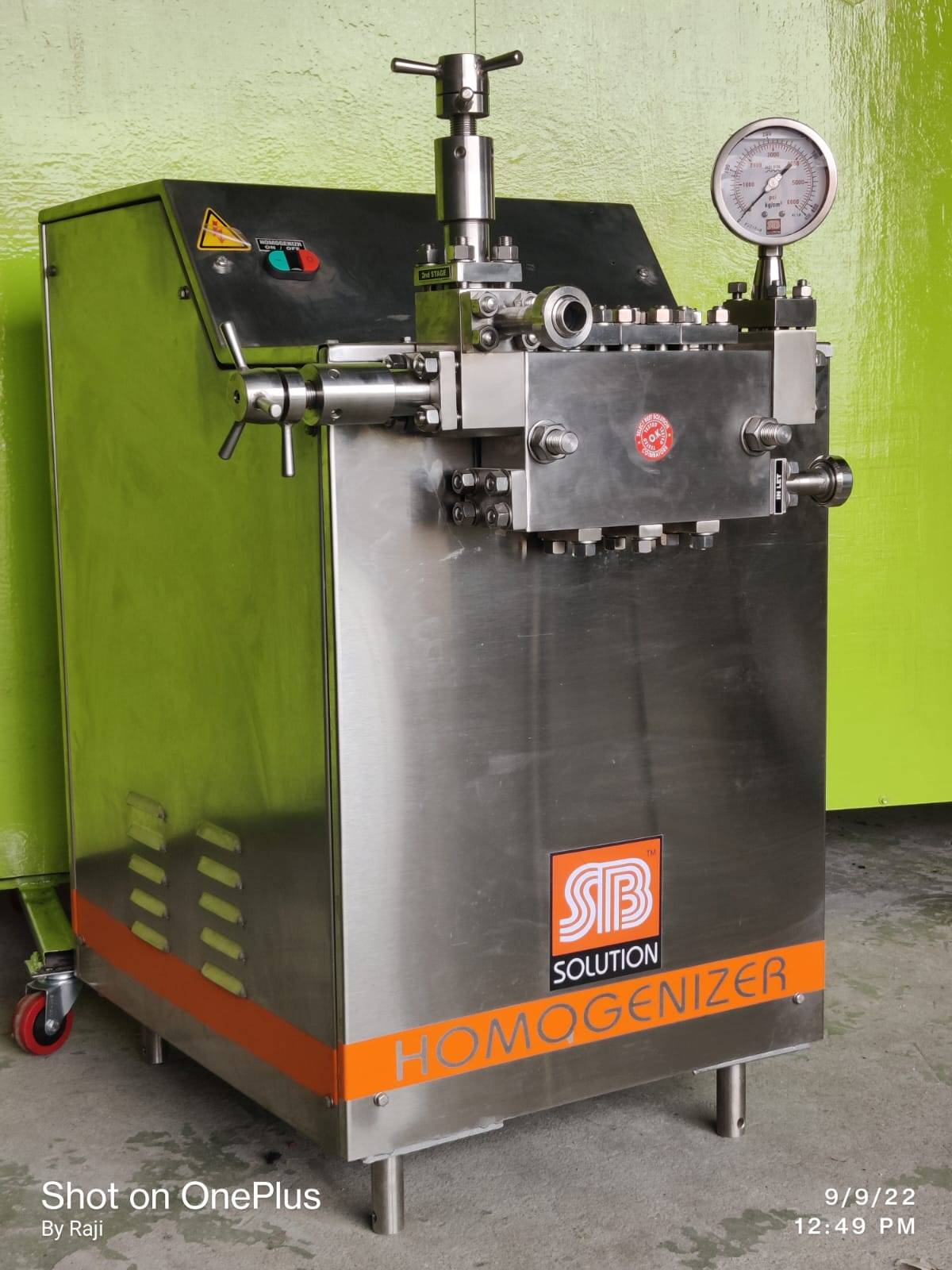 | Homogenizer Machine Manufacturers in Coimbatore - select best solution coimbatore View product → |
Frequently asked questions
How do you set thermal limits before homogenization?
Define the permitted milk temperature at tank outlet, heat exchanger inlet, homogenizer inlet and final cooling stage before commissioning. Use the milk specification and equipment manufacturer’s operating limits rather than treating ambient summer temperature as a setpoint.
Why should the storage tank, heat exchanger and homogenizer run as one sequence?
A coordinated sequence prevents warm delays, excessive cooling before homogenization and cream separation during stationary holding. Confirm transfer timing, agitation, heating, homogenization and cooling controls together.
How do you choose milk storage tank capacity for summer?
Calculate the largest expected batch plus the longest holding period, then check whether the cooling system can remove the incoming milk heat load while maintaining the required storage temperature. Size for actual production delays, not only nominal daily volume.
How do you match a homogenizer to the tank outlet and pasteurizer?
Compare the tank outlet diameter, pump capacity, pasteurizer flow rate and homogenizer rated flow and pressure. Check that valves, piping and controls prevent starvation, surging and pressure loss at the homogenizer inlet.
What should a hot-weather acceptance test include?
Run the complete line during the highest expected ambient conditions and record tank temperature, transfer time, inlet and outlet pressure, homogenizer flow, cooling performance and product uniformity. Accept the installation only when each value remains within the agreed operating limits.
Keywords